
Wearable
Camera and audio provide first-person field context.
FIELD TECHNOLOGY / CONTROLLED PILOT
US Construction Remodeling Corp. is testing a human-reviewed workflow that connects Meta smart glasses, an iPhone-based assistant, and our internal business systems. The goal is simple: help authorized field teams capture context, ask for help, and escalate potential concerns more clearly.
We combine wearable capture, the VS Assistant, and internal systems to help teams document conditions, communicate faster, and keep the right people connected to every next step.
Pilot brief / Sacramento / July 2026
This controlled pilot explores how wearable capture can help an authorized worker explain a field question with better visual context and reach the right reviewer faster.
The signal path
The glasses provide the field view. Our mobile and ERP systems connect each question to authorized people, project context, and a traceable business process.
Camera and audio provide first-person field context.
The mobile bridge manages connection, permission, capture, and audio.
The question and media become one organized conversation.
Identity, authorization, workflow, and records stay in the business system.
A manager or qualified person evaluates the context and chooses the next step.
Evidence ledger
The page separates verified tests, active pilot work, and third-party dependencies. That is more useful than a vague “AI-powered” claim.
Our signed iOS app launches on a physical iPhone, and the assistant interface displays both user and assistant messages.
The physical glasses were detected as connected and compatible. Basic audio routing and push-to-talk behavior were tested.
Mock-device tests verified capture, conversation attachment, and synthetic audio return. A prior controlled developer-mode test routed a real glasses photo into the team conversation.
Reconnect behavior, error recovery, worker training, privacy controls, and limited jobsite use still need repeatable validation.
Repeatable physical photo capture is being validated as Meta’s developer-preview provisioning continues to evolve.
Field sequence
The flow starts because an authorized person needs help or wants to document a specific condition.
The user avoids unrelated people, private areas, addresses, screens, and confidential documents whenever possible.
The iPhone app attaches the visual context to the assistant workflow instead of leaving it as an isolated photo.
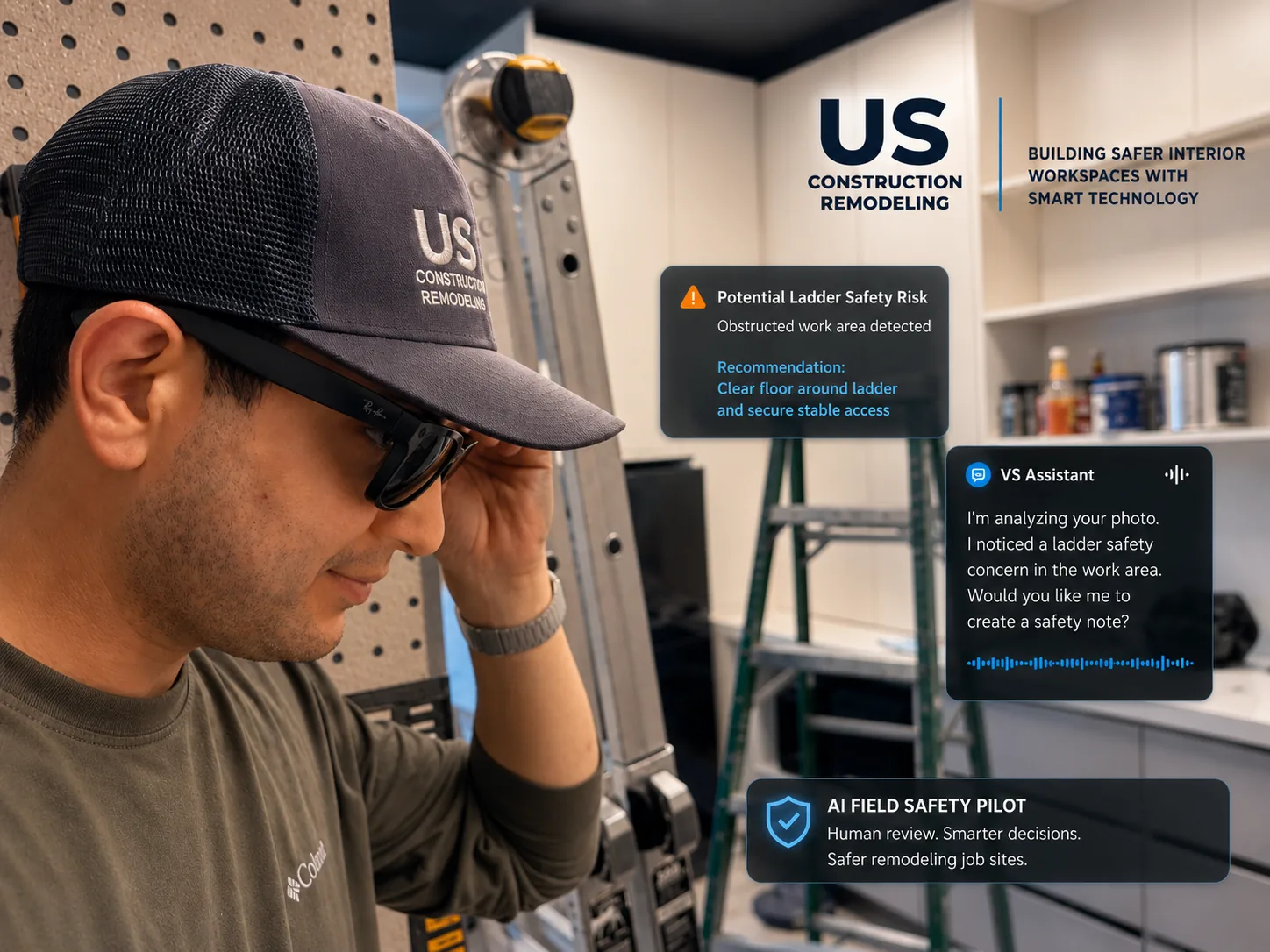
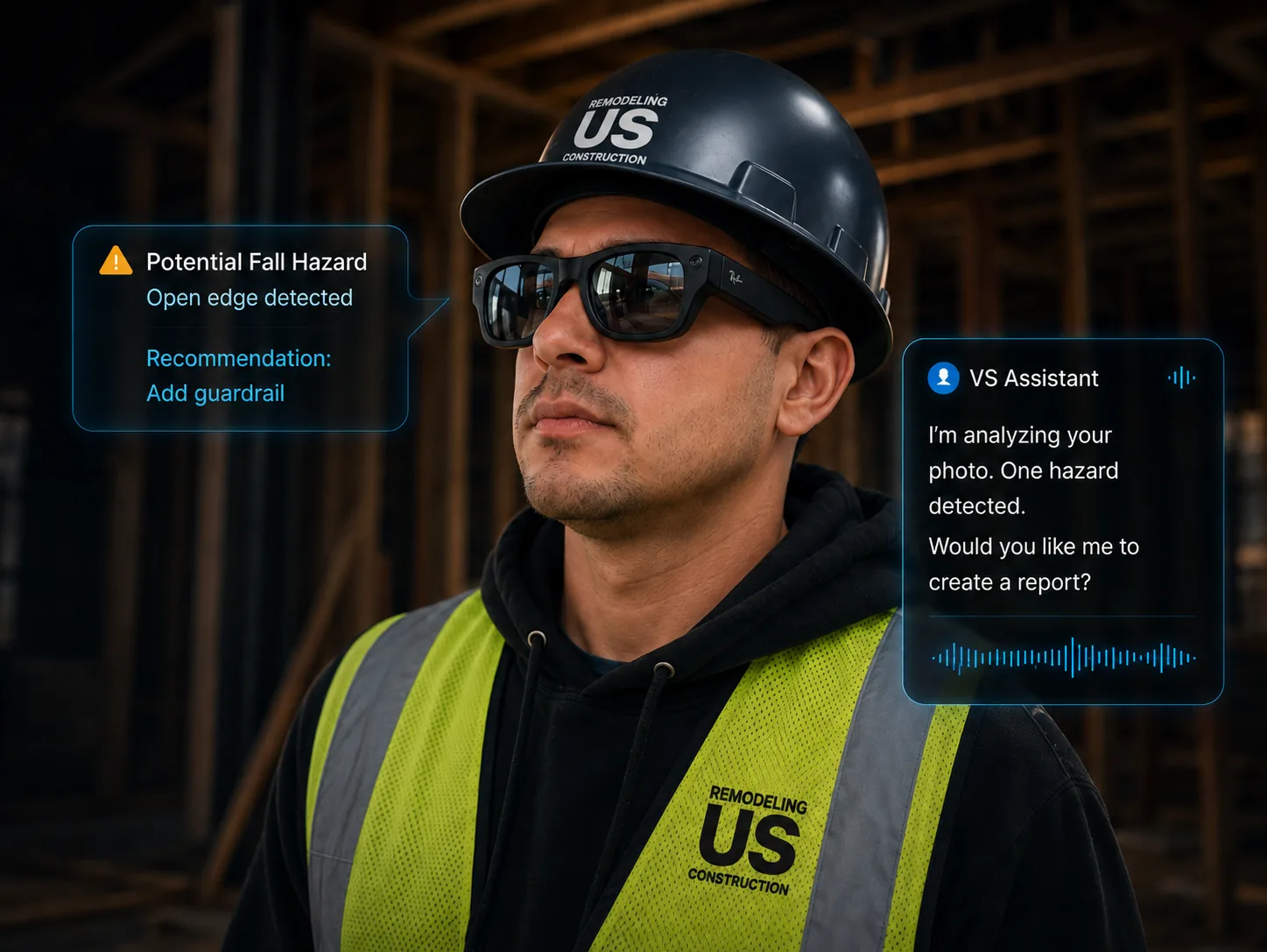
The assistant summarizes details or flags a potential concern so a qualified team member can evaluate it and choose the next step.
The question, media, human response, and next step can remain associated with the relevant business process.
The human boundary
AI-assisted field safety
Smart glasses and the VS Assistant help field teams capture visible concerns, share useful context, and move faster from observation to review.
Named author / traceable method

Chief Designer · US Construction Remodeling Corp.
Emin is the Chief Designer at US Construction Remodeling Corp. Emin leads client design meetings, measured layouts and 3D visualization in Revit, 3ds Max and Unreal Engine, and uses AI tools to speed up design and project planning.
Pilot FAQ
No. This is a controlled pilot, not a company-wide production rollout. We have verified the signed iPhone app, assistant interface, compatible glasses connection, basic audio route, and prototype media workflow. Wider deployment depends on repeatable field testing and the stability of Meta's developer-preview provisioning.
No. The assistant can organize visual context and flag a potential concern for human review. A qualified person remains responsible for evaluating the site, choosing controls, stopping work when necessary, and following the applicable safety program and regulations.
The intended workflow lets an authorized worker capture field context, ask a question, and route the photo and conversation to our assistant. A manager or qualified reviewer can then examine the information and respond through the existing company workflow.
Yes, in a previous controlled developer-mode test a real glasses photo reached the team conversation. Mock-device tests also verified photo capture, conversation attachment, and synthetic audio return. Physical capture is not yet a generally available feature because Meta provisioning must first become repeatable.
The pilot is being designed around authorized users, a defined work purpose, limited access, human review, and avoiding unnecessary capture. Images can contain personal information, so notice, access, retention, deletion, and vendor handling must be reviewed before broader deployment.
Meta and its product names are trademarks of Meta. We are evaluating Meta smart glasses and developer tools as one device layer in our own controlled workflow.
The next phase is to revalidate physical photo capture, document repeatable setup, test limited field scenarios, review privacy and safety controls, and measure whether the workflow improves escalation quality without distracting workers or replacing established procedures.
Pilot conversations / Sacramento
We welcome practical conversations with construction, safety, technology, education, and workforce organizations across the Sacramento region.