
Start with the fixed conditions.
Mark the walls, doors, windows and utilities you expect to keep. An opening to the backyard or a refrigerator beside a wall can rule out a layout that looks attractive in a photograph.
Kitchen layout planning · Sacramento
Compare six arrangements around the room you have, the people who cook and the routes you use every day.
The short answer
The best layout fits your room, daily routines and remodeling scope. Keep the useful parts of the existing arrangement, compare realistic alternatives and add an island only when the working and circulation space also fits.
Mark the walls, doors, windows and utilities you expect to keep. An opening to the backyard or a refrigerator beside a wall can rule out a layout that looks attractive in a photograph.
How many people cook? Who needs to pass through? Do you want seated preparation, a place for homework or easier access to everyday storage? Choose for those needs before choosing a shape.
Compare the options
Use the strengths and tradeoffs to narrow the choices. Two well-tested alternatives are more useful than a collection of inspiration images.
Two opposing runs make efficient use of a narrow room.
Tradeoff: A busy through-route can put people in the cooking area.
Check: Opposing appliance doors and traffic at both ends.
Two adjoining walls leave an open side toward another room.
Tradeoff: The corner and refrigerator position can limit useful prep space.
Check: Corner storage, window positions and the open-side route.
Three connected runs offer several work and storage locations.
Tradeoff: Corners and the main opening may become pinch points.
Check: Opposing counters, drawers and two people working together.
A single run keeps the kitchen compact and the room open.
Tradeoff: Storage, appliances and preparation compete for the same length.
Check: An uninterrupted prep surface and a place to set items down.
A freestanding unit can add prep, storage or seating.
Tradeoff: Its usable footprint includes space on every side.
Check: Counter overhangs, appliance openings and seating in use.
A connected counter can add a work surface or seating.
Tradeoff: The attached end can close off a useful route.
Check: Entry width, nearby doorways and access to corner cabinets.
Concept silhouettes show arrangements only. An island or peninsula can be combined with several basic layouts; the six options are not mutually exclusive.
Space around the island
Draw the complete countertop, including its overhang. Then account for the work on each side, seats in use and the route through the room. A cabinet box that fits does not prove the kitchen will work.
Include the surrounding cabinet runs, appliance projections and wall returns. A smaller island, a peninsula or no island may preserve a better route.
Check refrigerator drawers, dishwasher and oven doors, and corner cabinets. Look at where a person stands while using them, rather than only checking whether two doors collide.
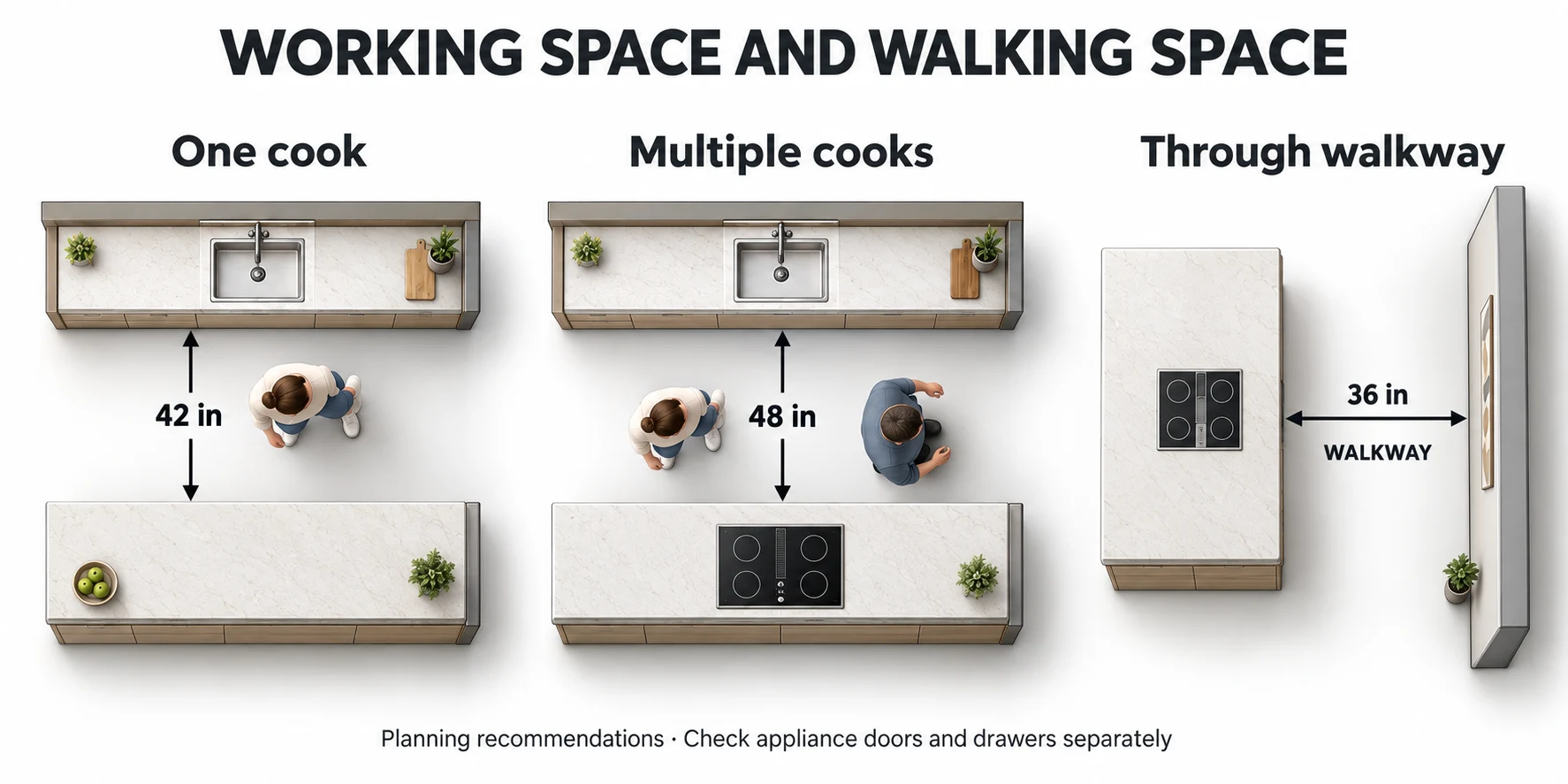 Open full-size aisles diagram
| Planning check | Published NKBA recommendation |
|---|---|
| Work aisle, one cook | At least 42 inches |
| Work aisle, multiple cooks | At least 48 inches |
| Separate walkway | At least 36 inches |
Source: NKBA Kitchen Planning Guidelines, guidelines 6–7. Measure between the applicable counter, tall-cabinet or appliance fronts. These published recommendations are planning references, not a California permit approval. Individual access needs and selected products may require a different arrangement.
Work zones
Trace storage, washing, preparation, cooking and serving. Keep frequently used items near the task, and consider whether a second person can make coffee or unload the dishwasher without interrupting cooking.
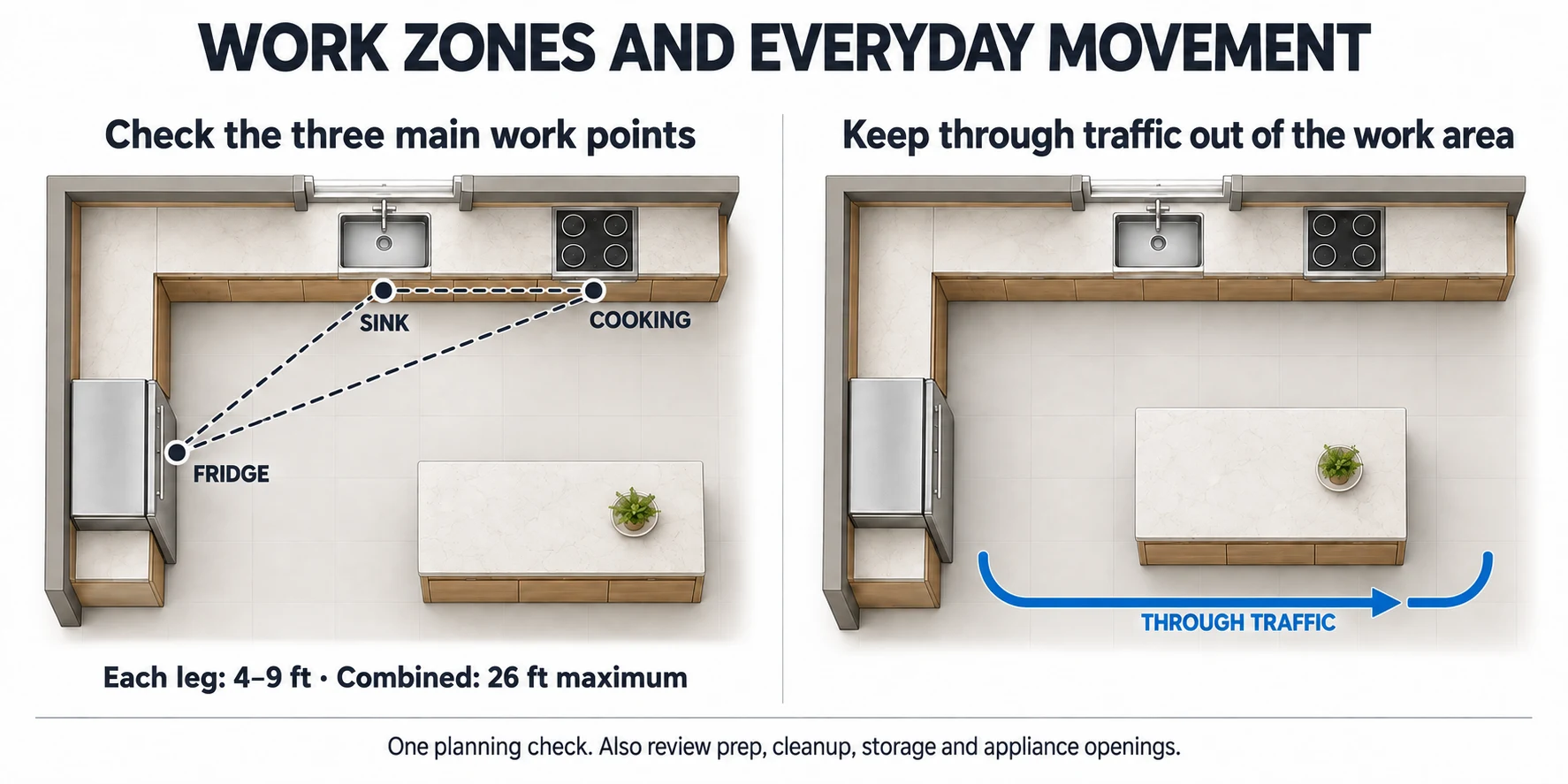 Open full-size triangle diagram
The published NKBA guidance, guidelines 3–5, describes 4–9-foot triangle legs and a combined maximum of 26 feet. A one-wall or multi-zone kitchen should be evaluated for its actual tasks rather than forced into this diagram.
Compare separate preparation positions, access to water and storage, and the handoff to cooking. Keep children and guests on a route that avoids the busiest work area.
Identify where groceries land, where produce is prepared and where hot dishes are set down. Check selected appliance instructions before finalizing nearby surfaces and installation clearances.
Seating and movement
Plan the occupied seat, not just the tucked-in stool. Consider the route to the dining room or backyard while chairs are pulled out.
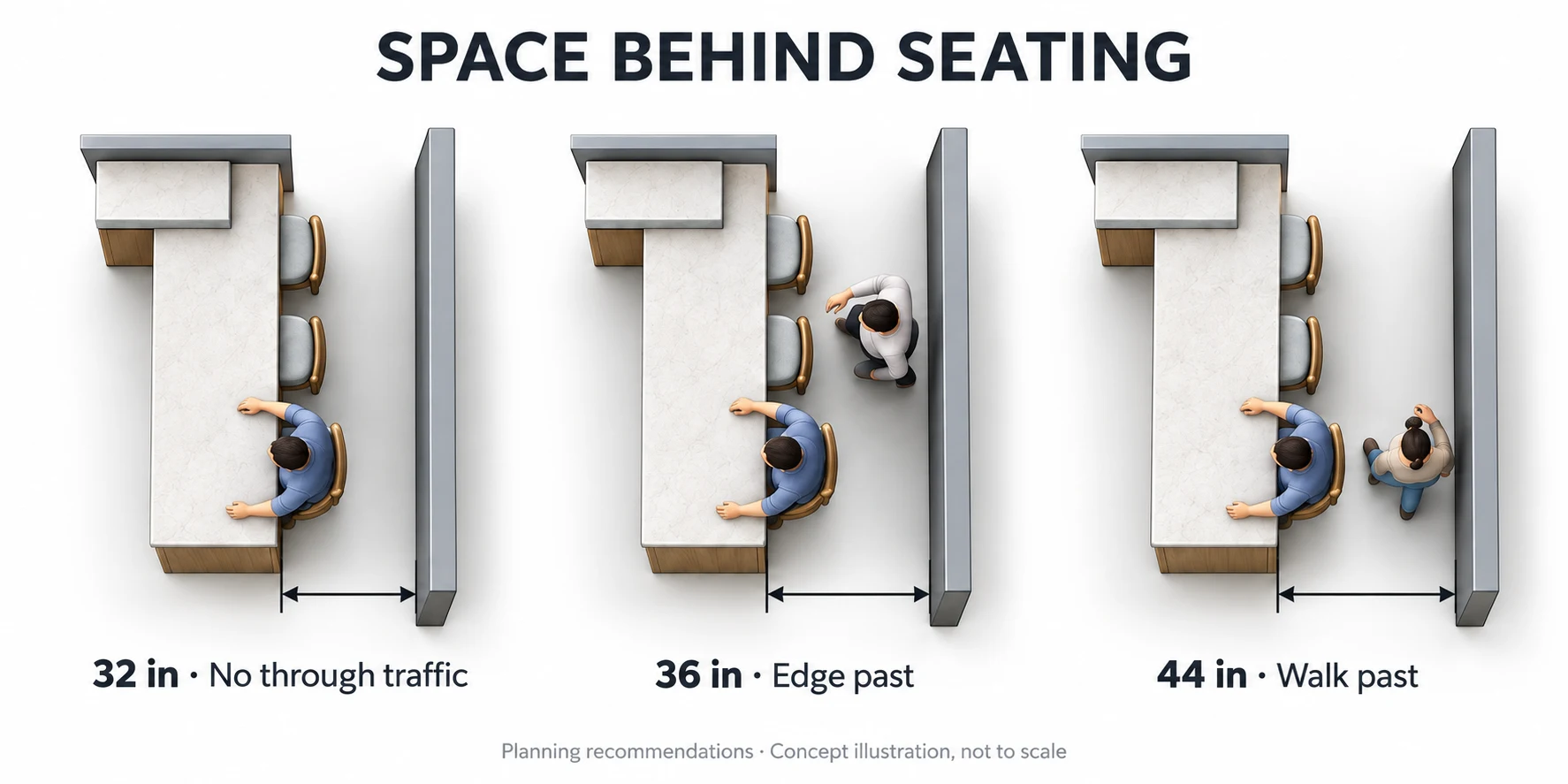 Open full-size seating diagram
Published NKBA guidelines 8–9: 32 inches for seating without through traffic, 36 to edge past, 44 to walk past. General knee-space recommendations per diner are 24 inches wide, with depths of 18, 15 and 12 inches at 30-, 36- and 42-inch counter heights respectively. These are not universal accessibility dimensions or approval for an unsupported countertop overhang.
Draw the dining table and every chair in the same measured plan as the kitchen. Test a pulled-out chair against pantry and appliance doors, and keep serving storage outside the preparation route. Locate the dining light over the final table position; a built-in bench also needs room for people to enter and leave.
Support brackets, end panels and cabinet backs must be considered when reviewing usable knee space. Coordinate the support design with the selected countertop system.
Discuss seated tasks, mobility aids, reaching and getting up from a seat. Test those needs with the actual household; one standard body diagram cannot describe everyone.
Bring photos, approximate measurements and the three things that are hardest to use today. Compare a layout-preserving option with a more extensive change.
Try it before committing
A coordinated 3D view can make the relationship between counters, storage, openings and the next room easier to discuss. Where included in the project scope, Unreal Engine or VR views can help you compare alternatives.
Compare an island with a peninsula, a taller pantry with a longer preparation surface, or seating with a clearer route. Review the model from the doorway, the work surface and a seated position.
Confirm which measurements and product models are included and whether appliance openings are represented. A visualization communicates a proposal; it does not replace field measurement, product instructions, structural review or permit drawings.
Scope before price
Compare what must be built, moved or repaired. A layout name alone cannot establish a cost or a construction duration.
Keeping suitable water, drain and appliance positions may reduce relocation work. It still requires checking the condition and suitability of the existing systems.
Identify the needed electrical, plumbing and ventilation work, floor repairs, cabinet changes and installation instructions. A cooking island and a storage-only island are different scopes.
Confirm its role before planning removal. Structural review, new supports, rerouted utilities and permit documentation can affect both cost and sequence.
Agree on appliance models, cabinet dimensions, countertop support, responsibilities and long-lead items. Separate design, approvals and procurement from the time spent building.
Sacramento permits
Start with the authority responsible for the property address. A Sacramento mailing address alone does not establish whether the City, County or another city handles the permit.
Prepare for the conversation
Take photos from each corner and record approximate dimensions for discussion. Do not remove finishes or open electrical equipment. Final dimensions must be verified before ordering or construction.
| Record | Include |
|---|---|
| Room | Wall lengths, room width, ceiling height and wall returns. |
| Openings | Door and window positions, sill heights, door swings and routes to other rooms. |
| Appliances | Exact model numbers, overall dimensions and manufacturer opening requirements. |
| Cabinets and counters | Finished depths, overhangs, handles, tall units and existing conflicts. |
| Visible utilities | Sink, visible connections, outlets and hood route. Mark unknowns as unknown. |
| Household | Number of cooks, seating goals, everyday storage and seated-use or mobility needs. |
Sources and related guides
The dimensional references above come from the linked NKBA PDF. Its code references use older model codes, so confirm the current California requirements for your project.
Planning references reviewed September 26, 2026. Concept diagrams explain relationships and do not establish construction dimensions.
Kitchen planning tool
Use the cabinet planning tool to organize doors, drawer fronts, finishes and installation assumptions after narrowing the layout. It cannot confirm that an island fits or inspect existing conditions.
Kitchen layout FAQs
Use these answers to narrow the questions for your project review.
Start with the room’s shape and openings. A galley may suit a narrow room, while an L-shaped or one-wall arrangement can keep another side open. Compare usable preparation space, storage, appliance openings and circulation.
Yes. Better storage, a different appliance position or improved preparation space may solve the problem without moving every wall or utility. Compare that scope with the benefits of a larger redesign.
No. It can use space efficiently, but its connected end can create a bottleneck. Test the entry, corner storage, seating and surrounding doorways before choosing it.
No. A working aisle serves counters and appliances, while a walkway carries through traffic. A single space may need to support both activities, so do not select its width from one label alone.
Use it as one planning check, not a universal rule for every arrangement. One-wall kitchens and kitchens with several work zones also need task-based evaluation.
No. They are published planning recommendations illustrated conceptually. Applicable codes, manufacturer instructions, structural conditions and individual access needs must be reviewed for the specific project.
Send your project address, room photos, approximate dimensions, known appliance models and the problems you want to solve. Mention seating goals, how many people cook, and which walls or utilities you hope to keep.
Tell us what is difficult today and what you hope to improve. Start a layout discussion for your Sacramento-area home.