Skip links

ROOTS / BREAKS / OFFSETS / RECURRING BACKUPS

Sewer Line Repair in Sacramento

Recurring sewer backups, roots entering the line, a cracked or separated joint, an offset, collapse, or deteriorated private sewer pipe can require more than another clearing. US Construction helps Sacramento property owners evaluate the evidence, compare focused repair with longer replacement, and define the access, permit, testing, and restoration scope before work is authorized.

CALL / REVIEW / EVALUATE / PROPOSE

Call with the history and available evidence.

Share the exact address, active-backup status, prior cleaning or repair history, cleanout access, and any camera video or written report. We confirm current assessment availability before dispatch; no repair method is promised from symptoms alone.

ACTIVE SEWER BACKUP

Stop using water before the backup spreads

Stop flushing toilets and stop using sinks, showers, washing machines, and dishwashers connected to the affected system. Keep children and pets away from wastewater, avoid direct contact, stay away from wet electrical equipment, and do not open a cleanout that may be under pressure. Do not mix drain chemicals.

Call (916) 234-6696 instead of waiting for the form. If several nearby properties are affected or the public collection system may be involved, confirm the serving utility before calling: City of Sacramento 311 or (916) 808-5011; SacSewer (916) 875-6730 for addresses in its service area. The EPA explains why sanitary-sewer overflows can create property and public-health risks. Review the EPA overview.
CALL
Confirm current urgent-assessment availability

WHEN CLEARING MAY NOT BE ENOUGH

Repeated symptoms can justify a sewer-line repair assessment

A backup or slow drain does not prove the pipe is broken. The pattern, recurrence, prior findings, and accessible evidence help determine whether the next step should be clearing, camera evaluation, locating, focused repair, or a longer replacement proposal.

01

Recurring backup after clearing

A line that works temporarily and then blocks again may need evidence beyond another service call. Roots, scale, debris, a belly, an offset, deterioration, or incomplete prior clearing can produce repeated symptoms.

02

Roots or damaged pipe previously documented

Previous video, photos, invoices, or written findings can help establish where to begin. They are reviewed as useful history, not accepted as a substitute for confirming current site conditions.

03

Equipment repeatedly stops at one area

A repeat stop can support additional investigation, but it does not by itself identify the pipe material, depth, exact location, or repair method. Access and locating conditions still matter.

04

Several fixtures or wastewater returning

Multiple fixtures, toilet-to-tub interaction, or wastewater at a lower drain can point to a shared downstream condition. During an active backup, stop using water and call.

CLEARING OR PHYSICAL REPAIR?

Restoring flow and repairing the pipe are different scopes

Drain cleaning or sewer clearing aims to restore usable flow by opening or removing an obstruction within the approved access and equipment limits. Restored flow does not prove that the pipe has no crack, offset, root entry, low area, deterioration, or other physical condition.

Sewer-line repair addresses a documented physical condition. The evidence may support a spot repair at one accessible section, a longer replacement, or further investigation before a responsible repair scope can be written. We do not present every recurring clog as a broken line, and we do not present clearing as a guaranteed permanent cure when the available evidence suggests a structural problem.

Before diagnostic, locating, excavation, trenchless evaluation, repair, or replacement work proceeds, the customer reviews the proposed scope and price.

CLEANOUT / CAMERA / LOCATING / SITE CONDITIONS

A camera provides evidence, but not the entire repair plan

Accessible cleanout

A known, safely accessible cleanout can affect equipment choice and the direction from which a line is approached. Tell us where it is and whether wastewater is visible nearby, but do not remove a cap during a backup.

Camera when evidence is needed

A camera may help document visible roots, joints, offsets, standing water, cracking, or damage when access and line conditions allow. CCTV is a recognized condition-assessment tool, but the result is limited by visibility and access. EPA technical record.

Clearing may come first

A camera cannot see through standing wastewater or a fully blocked, debris-filled line. Flow may need to be restored before useful visibility is possible.

What video can document

When conditions allow, video may show visible pipe condition, joints, roots, buildup, standing water, offsets, and damage. The relevant footage or still images should be tied to the proposed repair area.

What video cannot promise

Video alone does not guarantee exact depth or surface location, identify every material with certainty, expose soil and utility conflicts, show every hidden defect, or prove the full repair length.

Locating and site evaluation

A responsible excavation or access plan can require separate locating, utility marking, surface review, depth confirmation, and evaluation of structures, landscaping, traffic, easements, and restoration limits.

Spot repair

A focused repair may be practical when the defect is limited, its location and access can be established, and the surrounding pipe appears serviceable. The proposal should state exactly what length and restoration are included.

Longer replacement

Multiple defects, extensive deterioration, poor alignment, recurring root entry at several joints, or an unsuitable remaining pipe condition may support replacing a longer section rather than repeating isolated repairs.

Open excavation

Excavation can provide direct access and confirmation of the pipe and surrounding conditions. It may also involve utility marking, shoring or safe-slope requirements, backfill, compaction, inspection, and surface restoration.

Pipe bursting

Pipe bursting pulls a new pipe through the old alignment while breaking or displacing the host pipe. It is an evaluated option rather than a universal promise. Suitable access, alignment, connections, utilities, permits, and site conditions are required. EPA fact sheet.

Lining or other trenchless methods

Cured-in-place lining and other approaches have separate material, diameter, cleaning, connection, structural, access, and jurisdiction requirements. A method is proposed only when the confirmed condition and delivery arrangement support it.

Written customer decision

The proposal identifies the evidence, repair area, selected access method, permits, testing, backfill or lining assumptions, surface restoration, exclusions, schedule, price, and applicable warranty before authorization.

HISTORY / EVIDENCE / SCOPE / AUTHORIZATION

How a sewer repair scope is developed

We begin with the address, backup status, prior service history, known cleanout, available video or report, and the customer’s observed pattern. Current assessment availability is confirmed before dispatch. Onsite evidence and site conditions determine the recommended next step; a phone symptom alone does not.

01

Collect the history

Share the exact address, affected fixtures, recurrence, prior cleaning or repair, active wastewater, cleanout access, and any camera footage or written report.

02

Evaluate evidence and access

The assessment may review visible conditions, accessible cleanouts, available video, likely repair area, surface and structure constraints, utilities, public-right-of-way limits, and permit jurisdiction.

03

Compare responsible options

When supported by the evidence, the proposal can compare spot repair with a longer replacement and explain why open excavation or a trenchless approach may or may not fit the site.

04

Authorize, complete, and document

The customer reviews scope and price first. Authorized work is completed within the written limits, inspected or tested as applicable, and handed off with remaining conditions, restoration limits, and warranty terms.

SCOPE / PERMITS / UTILITIES / RESTORATION

The responsible repair path depends on the property and jurisdiction

Service area and availability: Sacramento and surrounding communities, including West Sacramento, Arden-Arcade, Carmichael, Rancho Cordova, Elk Grove, North Highlands, Rio Linda, Antelope, Citrus Heights, Fair Oaks, Orangevale, Folsom, Roseville, Rocklin, Davis, Woodland, Galt, Wilton, and El Dorado Hills. Assessment availability depends on the exact address, active condition, access, technician and equipment availability, and available records. Arrival or completion is not guaranteed.

Pricing factors: evidence and repair length, depth, pipe material and diameter, access points, roots or collapse, locating, utilities, structures and landscaping, traffic or occupied conditions, excavation safety, trenchless feasibility, permits, inspection, backfill, compaction, testing, surface restoration, disposal, and exclusions. The proposed scope and price are reviewed before work proceeds.

Permits and utility coordination: the City lists sewer repair and replacement as residential plumbing minor work. Its residential sewer guidance separates onsite permit work from tap work coordinated with Utilities. Work affecting a sidewalk, street, alley, or public easement can require a Public Works encroachment permit. Requirements outside City jurisdiction can differ. City minor permits · Residential sewer scope · Encroachment permits.

Before excavation: underground-installation locations must be requested and marked, and work near known facilities requires safe exposure and protection procedures. California excavation requirements.

Public-system routing: confirm the serving utility. City of Sacramento accepts reports through 311 or (916) 808-5011; SacSewer publishes (916) 875-6730 for sewer problems in its service area. Service Commitments.

Property and facility teams can also review commercial plumbing service for shutdown coordination, occupied-building access, and documentation.
Emin, Chief Designer at US Construction and Remodeling Corp.

Prepared by Emin

Service structure · Chief Designer
Emin organized the customer decision path, safety language, evidence limits, repair-method comparison, official sources, form flow, internal links, and mobile reading sequence. Meet the USC team.
Umit Sahin of US Construction and Remodeling Corp.

Technically reviewed by Umit Sahin

Contractor review · Project oversight
Umit reviewed sewer-line intake, camera and locating limits, spot-versus-longer repair decisions, access methods, permits, restoration responsibilities, customer authorization, testing, and field limitations. California contractor license #1117562.

BEFORE YOU CALL

Sewer line repair FAQ

How do I know whether I need drain cleaning or sewer line repair?

Drain cleaning aims to restore flow by removing or opening an obstruction. Sewer line repair addresses a documented physical condition such as roots entering a joint, a crack, break, offset, collapse, or deteriorated pipe section. A recurring backup does not prove that replacement is needed; the repair path should follow the available evidence.

What should I do during an active sewer backup?

Stop flushing toilets and stop using sinks, showers, washing machines, and dishwashers. Keep people and pets away from wastewater, avoid direct contact, and stay away from wet electrical equipment. Call (916) 234-6696 instead of waiting for a form response.

Does a sewer camera prove exactly where and how deep a defect is?

Not by itself. When access and line conditions allow, video may document visible roots, joints, offsets, standing water, cracks, or damage. A blocked or debris-filled line may need cleaning first. Depth, exact surface location, soil conditions, utilities, and the full repair scope can require additional locating and site evaluation.

Can only the damaged section be repaired?

Sometimes. A spot repair may be practical when the defect is limited, accessible, and the surrounding pipe is serviceable. Multiple defects, extensive deterioration, poor alignment, repeated root entry, or unsuitable access may support a longer replacement. The proposal should identify the evidence, limits, restoration, permits, and exclusions.

Is trenchless sewer repair always possible?

No. Pipe bursting, lining, and other lower-excavation approaches have different access, pipe-condition, diameter, connection, utility, permit, and site requirements. They are evaluated options, not automatic promises. Open excavation may still be the responsible method for a specific condition.

Should I call a plumber or the sewer utility?

If the condition appears limited to the property plumbing or private lateral, a plumbing service evaluation may be appropriate. If several nearby properties are affected or the public collection system may be involved, confirm the serving utility. SacSewer publishes a 24/7 problem line at (916) 875-6730 for addresses in its service area.

What should a sewer repair proposal explain?

The proposal should identify the observed condition, repair area, access method, included work, testing, permits and inspections, utility coordination, excavation or trenchless assumptions, backfill, surface restoration, exclusions, schedule, price, and warranty terms that apply to the proposed scope.

Do you evaluate residential and commercial sewer lines?

Yes, subject to the confirmed scope and current availability. Homeowners, landlords, and property managers can request an assessment here. Facility and business teams can also review USC’s commercial plumbing service for occupied-building access, shutdown coordination, and documentation.

DOCUMENTED FIELD WORK

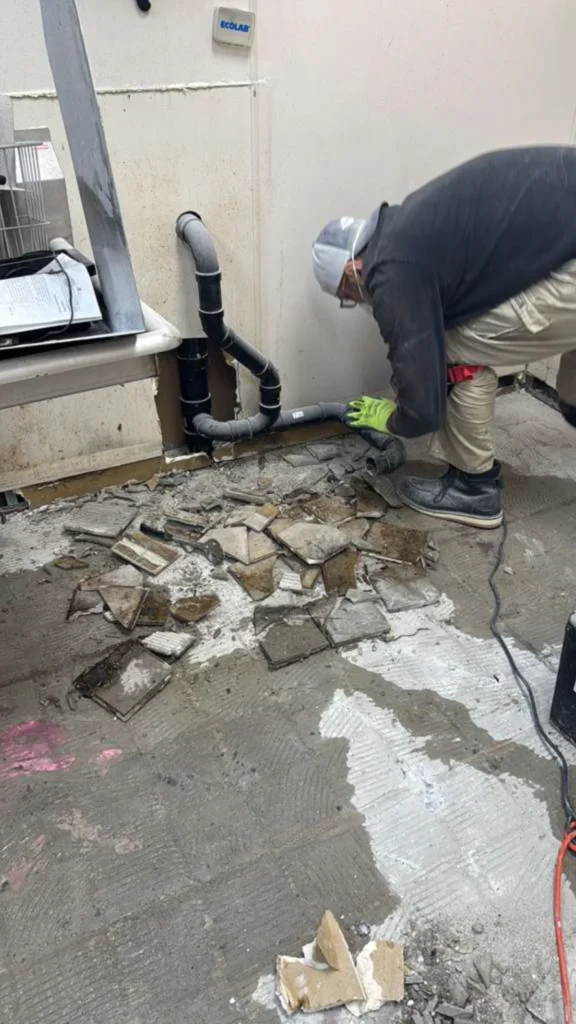
A documented USC sewer-line project

This Sacramento commercial case study records access, piping work, coordination, and restoration planning in an occupied business setting.

REQUEST SEWER LINE ASSESSMENT

Call now or send the available sewer-line details

Tell us the history, active condition, access, and prior evidence

Use this short form for an assessment callback. If sewage is actively backing up or water is rapidly rising, stop using connected fixtures and call instead of waiting for a form response.

    Important: Do not open a cleanout while sewage is backed up. Do not mix drain chemicals. For active wastewater or rapidly rising water, call (916) 234-6696.

    Check current service availability
    Call (916) 234-6696

    US Construction & Remodeling Corp.
    4424 Freeport Blvd Ste 4, Sacramento, CA 95822
    California contractor license #1117562.

    Sacramento plumbing services
    Commercial plumbing service
    About the USC team

    Current assessment availability depends on the exact address, active condition, access, technician and equipment availability, records, and site conditions. No repair method, arrival time, or completion date is guaranteed before evaluation.
    This website uses cookies to improve your web experience.
    Explore
    Drag